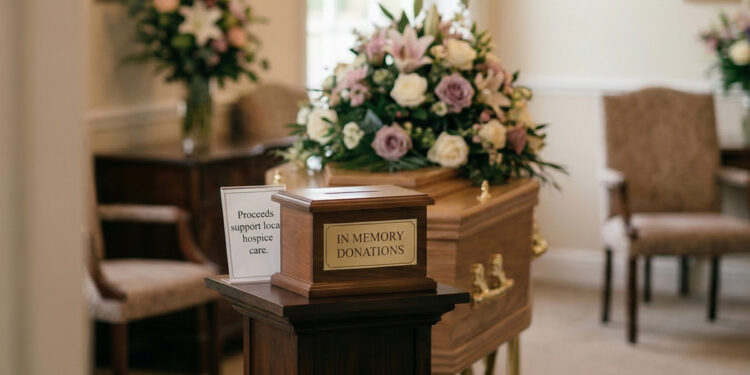
How in memoriam donations work at funerals (and why they matter)
Home»About Us»News»In Memoriam Donations: A Simple Guide to Funeral Charity Giving
Giving in memory of someone you love can feel like a small gesture.
But it often becomes one of the most meaningful parts of a funeral.
And the good news is this. Today, it’s easier, clearer, and more thoughtful than ever.
In this guide, we explain what in memoriam donations are, how they work today, and how they can help families create something positive during a difficult time.
If you are planning locally, you can also learn more about our funeral services in Tunbridge Wells and how donations fit into the wider process.
Donations are gifts to charity made in someone’s memory
Often chosen instead of, or alongside, flowers
Cash collections are now rare
Online tribute pages are the most common option
Donations go directly to the charity
Gift Aid can increase the value by 25%
What are in memoriam donations?
In memoriam donations are contributions made to a charity in memory of someone who has died.
They are usually collected during or after a funeral. Instead of sending flowers, friends and family can give to a cause that meant something to the person.
This creates a lasting tribute. Something that continues beyond the day itself.
If you’re arranging a service, you may also want to read about funeral arrangements in Tunbridge Wells, where donations can be included as part of the plan.
Across the UK, this approach has become more common in recent years [1].
How in memoriam donations work
In this short video, Simon Welham explains how donation practices have changed and why many families now prefer online tribute pages .
Why families choose donations instead of flowers
For many families, donations feel more personal.
They offer a way to turn remembrance into something that helps others.
Here’s why people choose them:
They support a charity connected to the person’s life
They help fund care, research, or local support services
They give friends and family a shared way to contribute
They create a lasting impact
Some families include donations as part of a celebration of life service, where the focus is on memories and meaning.
Others see them as a thoughtful option when considering funeral costs, allowing guests to give in a different way.
How funeral donations have changed over time
Not long ago, donations were collected in a very simple way.
You would often see a plate or envelope at the back of a church. People would leave cash, and it would be counted later.
But things have shifted.
Cash is used less often today. Banks are fewer. And handling money at a funeral can feel awkward or stressful [2].
So, what’s replaced it?
How funeral donations work today vs the past
Here’s a clear comparison of how things used to work and how they work now.
Aspect
Traditional Approach
Modern Approach
Payment method
Cash in envelopes or plates
Online donations, cheques
Collection process
Hand-collected at service
Digital and automatic
Tracking donations
Manual counting
Clear digital records
Transparency
Limited visibility
Fully traceable
Convenience
Local only
From anywhere
Security
Risk of loss or error
Secure systems
Extra benefits
None
Gift Aid adds value
This change removes pressure from families. It also makes the whole process clearer for everyone involved.
Planning in memoriam donations
Timeline: How in memoriam donations have evolved
The meaning behind donations has stayed the same. But how we give has changed.
Then → Now
Before 2000
Cash donations were the norm
Collection plates or envelopes used
Money counted manually
2000–2019
Cheques became more common
Early online donation options appeared
Charities improved tracking
Post-2020
Less use of cash
Online tribute pages became widely used
Remote giving increased
Today
Most donations are made online
Tribute pages include messages and photos
Donations go directly to charities
Families can see everything clearly
How online tribute pages work
Online tribute pages are now the most common way to collect donations.
Platforms like MuchLoved [3] allow families to create a dedicated page.
People can:
Donate securely
Leave messages
Share photos and memories
Funds go directly to the chosen charity, which keeps everything clear.
This is often used alongside services such as direct cremation, where simplicity is important.
Viewing vs wake vs funeral service. What is the difference?
by Simon Welham
Planning or attending a farewell for a loved one often involves unfamiliar terminology like viewing, wake, and funeral service. While these terms are sometimes used interchangeably, each represents a distinct event with its own emotional purpose, structure, and setting during the grieving process.
What is an exclusive right of burial? Funeral director explains
by Rebecca Welham
Planning a funeral or setting up a pre-paid funeral plan often involves complex legal terminology, with “Exclusive Right of Burial” being one of the most vital concepts to understand when choosing a final resting place.
Horse-drawn hearses are an elegant symbol of tradition at a funeral, but they can require more logistical foresight than a modern hearse. So here’s how to include a horse-drawn hearse in your loved one’s funeral.